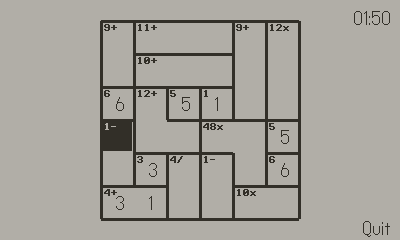
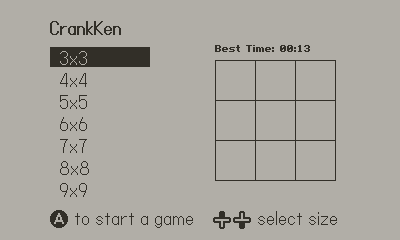
Hey everyone! I just released a first demo of CranKen, a KenKen math puzzle game built for Playdate. Would be nice to get some feedback. I’m working on it in my spare time.
Any feedback, issues, ideas are welcome. Basically, I wrote it for myself, as I like Sudoku and other math puzzle games. If you like Sudoku, KenKen is its arithmetic cousin: fill each row and column with unique digits, but cells are grouped into cages with a target number and operation (like 12x or
3-).
Sorry, should have explained it a bit better.
CranKen rules can be a bit unclear at first.
Rows/columns: Yes, digits can’t repeat within a row or column.
They do start at 1 and go up to the size of the grid: 4×4 uses 1–4, 6×6 uses 1–6, 9×9 uses 1–9, etc.
They’re not required to be consecutive in order, just all different.
Cages & operations: The label tells you what the numbers in that cage must do.
12× means the numbers in that cage must multiply to 12 (not “a multiple of 12”).
7+ means they must sum to 7 (not “7 or more”).
3− means the difference is 3 (usually a 2-cell cage).
2÷ means the quotient is 2 (usually a 2-cell cage; either order is allowed, e.g., 4 and 2).
Hope that helps. Will try to add an example video/gif to the website.
Thanks, I played a couple rounds now and it’s quite engaging when it works but there’s some issues that I stumbled upon and they might be related. Some puzzles I just couldn’t solve, even small ones, because taking all constraints in the puzzle together I just jumped from one field to the next and could reduce the numbers for a field but never found a field that had just one possible number. Maybe this needs the approach many Sudoku games take where you can exclude the numbers in the game until there’s only one left so you don’t have to do it in your head.
At the same time I had several puzzles that had multiple solutions. In one game I had 8 numbers that I could swap out in groups of 4 to create 4 different valid solutions. That can be a bit confusing if you don’t expect it and is not nearly as fun as solving a puzzle with just one solution. The puzzles I described above might also fall into this category but there were too many numbers involved to find out if that was the case.
Here’s a simple example of a puzzle with two solutions.
Thanks a lot for the help and test! There must be something wrong with the generator then … It should test that there’s only one feasible solution. Will look into it.
The game itself is still in an early stage of development (my first one to do for the play.date).